

I'm anti-GenAI - Let's Talk about Why
From Environmental impact to Brainrot, there's a lot wrong with GenAI.


AI Disclosure: This post is 100% organic content generated by a real human. No generativeAI was used in its creation.
My last two articles have been very critical of AI. The first is about why I hate AI, and the second is about my own proverbial “Come to Jesus” moment with AI. In both, I wrote about why I arrived at those decisions, but I left out the depth of those decisions. It helps to allow others to see the ethical calculus I’m using. I can’t go into as much detail as I want because this article would be more of a book.
I’m going to break this down into how I’m thinking about the ethics. In the first, I’ll talk about what I’ll call the macro-ethical situation - things that are bad but don’t immediately impact me. In the second, I’ll talk about the personal ethical situation - what I see as bad and that immediately impacts me. Finally, I’ll look at the perceived value I get from AI compared to the harm it does.
AI can go wrong in different places. You can check out my article on the 3 Different Places to Think About Ethics in Tech and AI to get more details.

To start, I’m going to define what I mean when I say AI. In most cases, I use AI as shorthand for genAI because it’s easier to type. There is, in fact, a great deal of what’s part of “Artificial Intelligence” that isn’t as problematic as generative AI. I’m talking about generative AI, driven by large-language models (LLMs), not traditional AI models.
Macro-Ethical Concerns
Macro-ethical concerns are big, broad concerns. They are ethical concerns that don’t directly impact me, but harm other people or things. It’s also where much of the harm from generative AI comes into play, upstream of the individual.

Environmental Impacts
The environmental impacts of generative AI are profoundly bad.
Recent Google Gemini claims state each text-only prompt requires about .25mls of water for cooling. Images and videos need significantly more. For comparison, running a Google search uses about .0003mls of water. This is a big decrease from the ~5mls of earlier models. But we are prompting more than before. ChatGPT alone accounts for around 2.5 billion prompts per day in late 2025, compared to 1 billion prompts per day in early 2025. Any gains that have earned have been obliterated by the scale of use.
Energy usage will exponentially increase at the same time. In the past, training the models was the most energy-intensive part of the AI pipeline (that’s where all the crazy math happens). But recently, the inference — what happens when you prompt with genAI — has skyrocketed. It accounts for 80% of the total energy usage in AI, and it’s going to keep going up.
This energy generation also increases generative AI’s carbon footprint. It’s hard to speculate on how bad it is, given the lack of data. But we can say it’s not helping the situation.
Using generative AI, even a few prompts, has a negative impact on the environment.
Intellectual Property
It’s no secret that generative AI exists today because companies like ChatGPT, Anthropic, and Google stole the intellectual property of billions of people to train their models (while, humously, getting all bent out of shape when someone steals their IP). They can only exist because they stole intellectual property, and regulators around the world are unable to deal with the scale of the theft. No one before has stolen so much from so many people, and governments have no idea how to respond. So they … haven’t.
Every sentence genAI creates benefits me because of the uncredited work of other people. As a writer myself, I think about how it would feel to have someone steal my content, and then tell me that I should be grateful for the opportunity because ‘progress’.

Data Labeling
We treat AI like it’s magical, and the math behind it does all of this without any human input. But that’s not true - frontier model developers like Anthropic, ChatGPT, and Google use workers in third-world countries to label data — often including graphic, toxic, sexually explicit data to help train the models. They work arduous, long hours for pennies and are exposed to content so graphic that many develop psychological and mental health issues as a result. They consume literally the worst that humanity has to offer so that the rest of us don’t need to, and they get exploited to do it.
I think about the trauma these people experience in order to make generative AI safe and useful for us. They do it because they have no other options, not because they feel passionate or driven. They sacrifice their mental health so they can just barely scrape by with enough money to provide meager support for their family.
And Some More …
AI job replacement is a concern, but not a big one. Companies that are laying off to “replace people with AI” are lying - AI cannot replace a single person. Those companies overhired and are using AI as a scapegoat. AI fails at about a rate of 95% on longer, complicated “real-world tasks outside of the carefully curated benchmarks.
AI Psychosis is becoming a bigger and bigger problem.
AI-based cheating continues to grow in high school and colleges, creating a marked lack of learning.
Personal Ethical Concerns
These are ethical concerns that impact me. I broke these out because it’s easy to ignore or gloss over the ‘macro-ethical’ concerns and focus on the personal ethical concerns.

AI Brainrot
The father of modern karate, Gichin Funakoshi, said, “Karate is like boiling water; without heat, it returns to its tepid state.” Using your brain is the same. Outsourcing my critical thinking to AI so that I don’t have to think is counterproductive. Not only do I understand my work less than if I had done it myself, but I am also ensuring I am less capable of doing the work on my own in the future.
There’s a growing body of work about the negative impact of long-term AI usage on our cognitive abilities - termed brainrot. The takeaway boils down to this: as we outsource more of our thinking and our work to AI, we get worse at it ourselves. There is always value in the doing. If it’s worth doing, it’s worth spending my time and energy to do it well.
The Human Factor
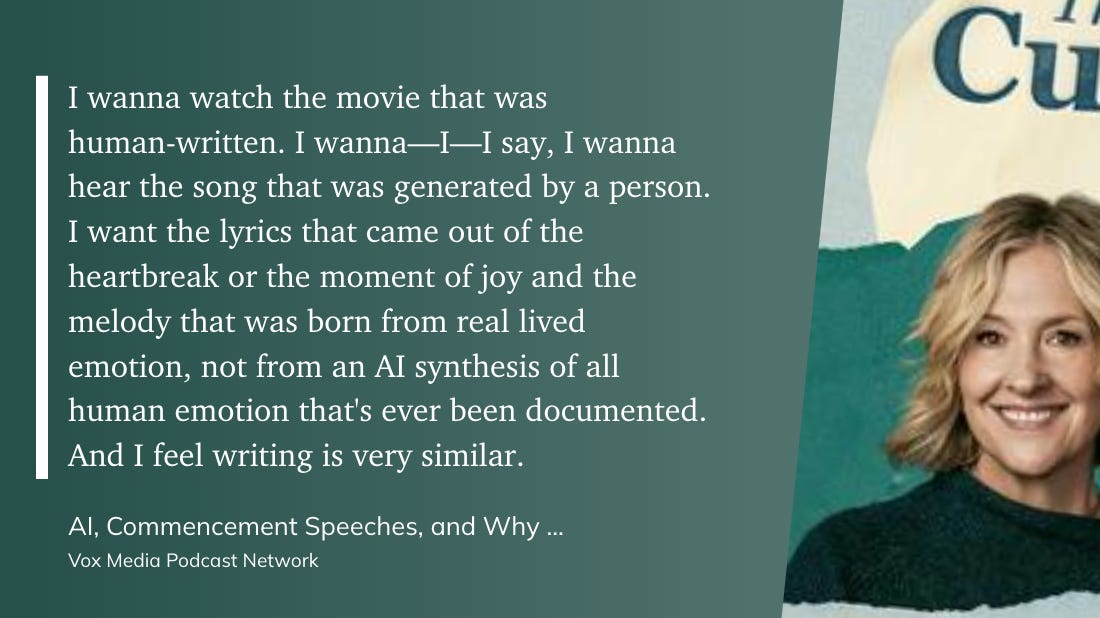
I’m going to steal a comparison from Adam Grant and Bréne Brown on the Curiosity Shop podcast, where Adam compares AI-generated content to the Enhanced Games. I love this comparison because there’s something powerful about the unaltered human experience. I don’t want a machine’s auto-completion of a statistical likelihood of this emotional experience. I want the messy, chaotic human experience. If that’s what I want, how do I do anything other than give other people the same courtesy of my own messy, chaotic experience?
The Grossness of AI
I don’t feel good when I use genAI. I feel gross. I feel like I’ve cheated myself out of something fundamental. I feel like I cheated whoever’s going to receive my work out of something critical—out of the ‘me’. People aren’t paying me for whatever I can prompt genAI to give. They are paying for me, for my experience, my perspective, for the “Andy” factor. GenAI can’t give any of that. I feel like I’ve taken a shortcut that wasn’t worth the time it saved, because genAI produced work that I would never accept from myself.
A small number of companies created generative AI to make it so I can’t function without them. The created genAI to make people who are already rich even richer. Every benefit, every positive (and negative) thing that comes from genAI starts there.
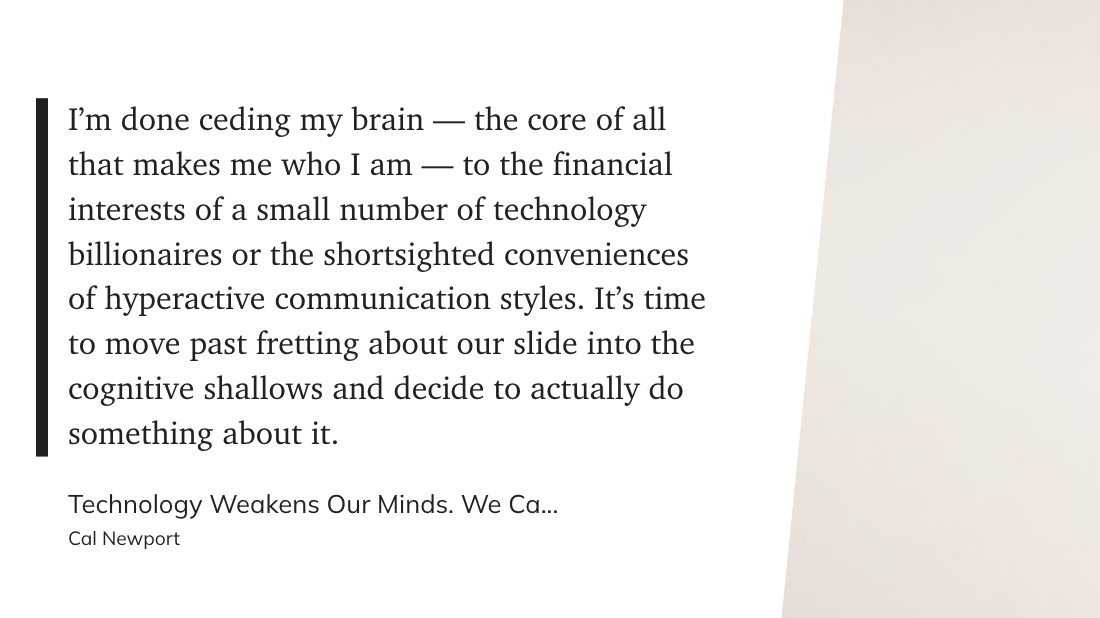
This quote from Cal Newport resonated with me.
The Value genAI Brings
The primary value that genAI brings is time, but always at a cost. If you have it summarize notes, you’re less likely to remember what was discussed in the meeting. If it helps you brainstorm, you’ll get a weaker outcome because genAI won’t challenge your thinking. If you have it create a product spec, you’ll miss the gaps in your design. It will free up your time, but you’ll fill that time with more of everything else.
I can do more, people on LinkedIn tell me. I can do in hours what would take weeks. More, they say, is better. More is progress. But they never stop to ask if more is the right answer. You’ve lost something profound if you don’t need to consider if your solution is the right answer. More is not better. Quantity doesn’t supersede quality.
More is the enemy of great.
Conclusion
Even though I was benefiting a little from using genAI, it wasn’t much. I’ve never subscribed to hustle culture. The argument that I could do more never held weight for me. What I want is better, not more. I want greatness in my work, not celerity. I want to create less, but have a greater impact. Generative AI is never going to get me to great.
GenAI is terrible for the world for more reasons that I brought up here. Like I said, I could turn this into a book. But this is how I think about genAI. Hopefully, this will help someone else as we navigate these treacherous waters together.
Thanks for specifying “gen AI.” I think folks over index on the broad term of “AI,” without understanding it’s far more complex than that.